



Exploring the Strategies of the Petro Card Game
Tired of the same old card games? If you’ve ever played Uno or Monopoly and wished for a little more strategy—a chance to build something of your own—then you’re in the right place. The Petro Card Game isn’t about getting rid of your cards first; it’s about using them to build an oil empire from the ground up, one clever move at a time. Check out RESTU189 to know more
Imagine holding an entire company in the palm of your hand. You start with a little cash and a lot of ambition, scouting for land, drilling for oil, and building refineries. Your goal is simple: become the wealthiest tycoon at the table. In practice, this means turning your hand of cards into a money-making machine that gets more powerful with every turn you take.
“Strategy game” might sound intimidating, but learning how to play Petro is surprisingly straightforward. Forget thick rulebooks. This guide is designed to teach you the essentials in the next few minutes, taking you from a curious beginner to someone who’s ready for their first game. We’ll cover the core goal, how to take a basic turn, and the secret to building your economic engine.
Petro is a fast-paced game of wits where you react to a changing market and outmaneuver your rivals. There’s a special kind of satisfaction that comes from watching your carefully planned company start generating cash, all while your friends are trying to do the same. Simple enough, right? Let’s drill into the details.
How Do You Win at Petro? The Simple Path to Becoming a Tabletop Tycoon
So, after all the drilling and dealing, how do you know who came out on top? The answer is simple: the player with the most money wins. But in Petro, “money” means more than just the cash in your bank. It’s about building a valuable empire, and everything you own contributes to your final score. This keeps the game competitive right down to the very last play, as a single, smart investment can change everything.
Your final score isn’t just your cash on hand; it’s the total value of your entire operation. Think of it like selling your business at the end of the day. You’ll add up your cash plus the worth of any special items you’ve created, which the game calls Assets. For example, those valuable ‘Gasoline’ tokens you produced are a critical part of your final total, and often they’re worth far more than the raw cash you have sitting around.
This final tally happens at a very specific moment. The game end is triggered as soon as one player draws the very last card from the main deck. At that point, the game is over and everyone counts up their cash and the value of their Assets. This creates a fun and tense race to build your most profitable ventures before the cards—and your time—run out.
What Are the Tools of an Oil Tycoon? Your Starting Cards and Tokens Explained
To build your money-making empire in the Petro card game, you need the right tools and a place to work. Every action you take will involve a combination of three core components: Land cards, Equipment cards, and the Resource tokens they generate. Understanding how these three simple pieces work together is the key to mastering the game.
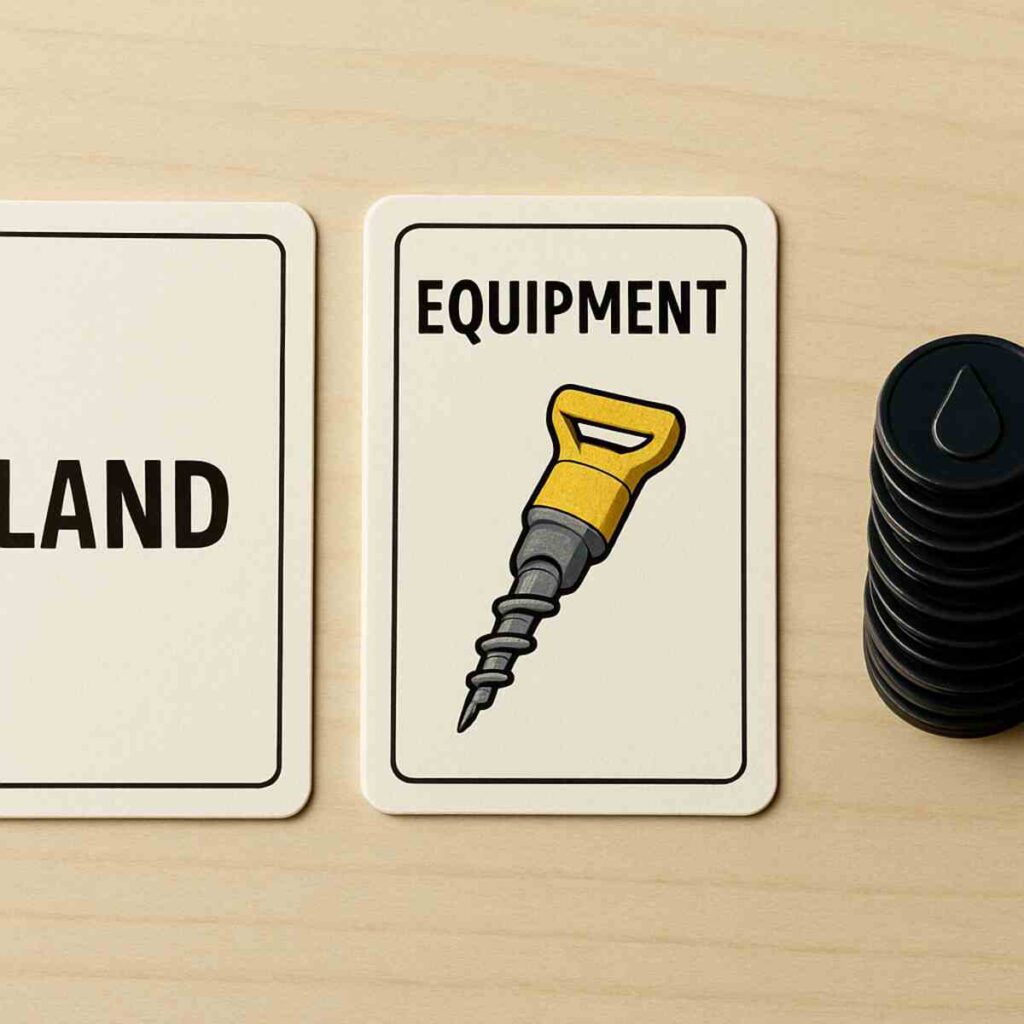
Think of Land cards as the foundation of your business. On their own, they don’t produce anything, much like an empty plot of real estate. However, you can’t build anything or start drilling for oil without first owning the land to do it on. Playing a Land card from your hand is you staking your claim and creating a space for future growth.
Once you have your land, you need to put it to work. That’s where Equipment cards come in. These are the tools and machinery of the industry, with the most basic being the ‘Drill Rig.’ By playing a Drill Rig card onto one of your Land cards, you’ve just created your first active well. This combination is what allows you to start generating income.
Finally, all that drilling has to produce something tangible. Every time your equipment produces, you’ll collect physical tokens. At the start, this means taking black Oil tokens from the supply. These tokens are the raw resources that represent your company’s output. They have a base value, but as you’ll soon see, the real key is turning this simple crude oil into something much more profitable.
How to Play Your First Turn and Immediately Start Producing Oil
Now that you know what the pieces are, let’s put them into action. A turn in Petro is refreshingly straightforward and follows a simple, three-step rhythm. The goal is to get your oil business up and running as fast as possible. Every single turn, you will:
- Draw one card from the main deck.
- Play one card from your hand (or choose to pass).
- Collect income from everything you have built.
The most important part of your turn is the “Play” phase. This is where you build your empire. If you have an empty Land card on the table and a Drill Rig in your hand, you can play the Drill Rig directly on top of the Land card. This simple action creates your first productive oil well! You can also play a new Land card from your hand to prepare for future expansion. Making the right play is the heart of Petro’s strategy.
Finally, after you’ve made your move, you get paid. This is the “Collect” phase. You look at all the completed wells you have on the table and collect one black Oil token for each one. So, if you just played your first Drill Rig onto a Land card, you immediately collect your first Oil token. Congratulations, you’re officially in the oil business! But as you’ll soon discover, that raw crude oil is just the beginning.
Why Crude Oil Isn’t Enough: Using Refineries to Multiply Your Money
Collecting those black Oil tokens feels great, but you’ll quickly notice a problem: your opponents are doing the exact same thing. A table full of players all producing oil means you need a way to stand out. Simply piling up barrels of crude isn’t enough to secure a win. To truly pull ahead, you need to turn that basic resource into something far more valuable.
This is where special cards called Refineries come into play. A Refinery is a powerful upgrade you can build that doesn’t produce new resources on its own, but instead lets you transform the ones you already have. Once you have a Refinery card on the table, you gain a new ability: on your turn, you can trade in two of your basic Oil tokens to take one red Gasoline token. Think of it as turning raw ingredients into a finished product.
That conversion is the secret to building your fortune. While it might seem like you’re giving up two tokens for one, the payoff is huge. When it comes to the final tally, a single red Gasoline token is worth five times more money than a single Oil token. Building a Refinery early is a core part of any winning strategy. But the value of your oil and gasoline isn’t always stable; sometimes, unexpected events can shake up the entire market.
What Are ‘Market Event’ Cards and How Do They Shake Up the Game?
Those unexpected market shifts come from a special deck of Market Event cards. At the start of each new round of play, one of these cards is flipped over for everyone to see. Think of it like a “Community Chest” card in Monopoly—it introduces a temporary rule that changes the game for all players. This card acts as the ‘trump suit’ for the round, setting the economic climate and forcing everyone to react.
The effects of these cards can be dramatic. For example, a “Price Boom” might be revealed, doubling the value of all Gasoline tokens sold that round, creating a huge payday for anyone with a Refinery. On the flip side, you could draw a “Global Recession” card, which forces every player to discard half of their cash on hand. Suddenly, the player who was hoarding money is on the same level as everyone else, creating a tense and exciting scramble to recover.
This constant ebb and flow is what keeps every game of Petro feeling fresh and unpredictable. A common mistake new players make is having only one rigid strategy. One of the more advanced petro playing techniques is learning to adapt on the fly, as a Market Event can instantly make your perfect plan worthless. You can’t just sit back and watch your empire grow; you must be ready to pivot. These events directly impact the value of your assets, which is critical when it comes time to count your fortune.
Your Official Petro Scoring Guide: How to Calculate Your Final Fortune
After all the wheeling and dealing is done, how do you determine the winner? Calculating your final fortune is a simple process of converting all your hard-earned assets back into a final dollar amount. This is where the specific value of each card and token really pays off. The game isn’t over until the final barrel is counted, and this guide will show you exactly how to do it.
We recommend using a scoresheet for the final tally. To make it even easier, you can use our printable petro score sheet to track everyone’s totals. Just follow this simple checklist for each player:
- Final Scoring Checklist:
- Count Your Cash: Start with the easiest part—add up all the physical cash you have.
- Value Your Oil: Count your ‘Oil’ tokens. Each one is worth $2.
- Value Your Gasoline: Now count your ‘Gasoline’ tokens. These are much more valuable, worth $10 each!
- Add Card Bonuses: Check your cards for any with a “Final Score” bonus listed on them and add that to your total.
- Find Your Grand Total: Sum all the values for your final score. The player with the highest total wins!
As you can see, while your cash on hand provides a solid base, the real key to a winning score lies in upgrading your resources. A single ‘Gasoline’ token is worth five times as much as a basic ‘Oil’ token! This simple fact is at the heart of the game’s strategy, and failing to appreciate it is one of the most common mistakes new Petro players make.
The 3 Most Common Mistakes New Petro Players Make
Knowing how to count your money is one thing; knowing how to make more of it than your rivals is another. After teaching Petro to dozens of new players, we’ve seen a few common mistakes crop up time and again. Avoiding these simple traps is the first step toward developing more advanced playing techniques and turning a casual game into a decisive victory.
The biggest error is treating your cash like a treasure to be hoarded. Money sitting in your hand earns you nothing. Instead, think of your cards and tokens in play as an engine that works for you every turn. Your cash is the fuel for that engine. Spending it on assets like Drills and, especially, Refineries is crucial. As you saw in the scoring guide, a single Refinery can turn $4 worth of Oil into $10 worth of Gasoline, an investment that pays for itself almost immediately. Not building this engine is the fastest way to fall behind.
Another frequent pitfall is focusing only on your own little empire. Petro isn’t a solo game; you’re in direct competition for limited resources and opportunities. If you spend your whole turn calculating your own perfect move, you might miss that your opponent is quietly collecting the exact cards they need to build a powerful pipeline for a massive end-game bonus. A quick glance at their operations can inform your own basic bidding strategy—perhaps it’s better to buy that Land card they desperately need, even if it’s not your first choice.
By investing your cash and keeping one eye on your competition, you shift from simply playing your cards to actually playing the game. This awareness is key, because a smart move doesn’t just benefit you; it can also disrupt an opponent’s plan. The strategic importance of these decisions changes dramatically depending on who you’re playing against.
How Petro Plays Differently with 2, 3, or 4 Players
The number of rivals you’re facing at the table completely changes the feel of the game. When playing Petro for two players, the experience becomes a tense, strategic duel. Every card you buy and every move you make is a direct response to your sole opponent. You can focus entirely on countering their strategy and blocking their access to key resources. It’s a cut-throat mental battle perfect for those who love seeing the immediate impact of their decisions in a head-to-head showdown.
On the other hand, a four-player game transforms Petro into a more chaotic and social event. By the time your turn comes around again, three other people have acted, often changing the board completely. This makes complex, long-term plans harder to pull off and rewards players who can adapt quickly and seize sudden opportunities. You’re not just trying to outsmart one person; you’re navigating a whirlwind of shifting deals and unexpected plays, which makes for a louder and more unpredictable game night.
Playing with three people creates a fascinating middle ground. It often introduces a “kingmaker” dynamic, where two players pull ahead and the third player’s moves become critical in deciding the winner. While the core rules don’t change, the optimal strategy certainly does. This flexibility ensures the game adapts to fit your group, whether you prefer a calculated duel or a rowdy party.
Is Petro Like Pinochle? Understanding Its Place in the Card Game World
Many people are familiar with traditional “trick-taking” games like Pinochle, Hearts, or Spades, where the goal is to win individual rounds using the cards you’re dealt. Petro works on a completely different principle. It isn’t about winning short-term hands; the cards you start with are just the beginning, and their real value comes from what you turn them into over the course of the entire game.
Petro is an “engine-building” game. Instead of playing cards to win a single round, you play them to create a system that generates value for you turn after turn. You play a “Drill Rig” card on top of a “Land” card, and that combination now acts like a small machine, producing an “Oil” token for you each round. Your goal is to keep adding new parts to your machine—like a “Refinery” to make your oil more valuable—creating an economic engine that runs better than everyone else’s.
This focus on long-term building means the origin and history of Petro are closer to modern board games than to old-fashioned card games. If you’ve ever played a game like Catan, where you gather resources to build settlements and cities, you’ll immediately recognize the feeling. Card games similar to Pinochle focus on managing a single hand, but Petro is about building an empire from the ground up.
You’re Ready to Play: Your First Game in 3 Simple Steps
You’re now equipped to make strategic choices, build an engine, and stake your claim as a tabletop tycoon. To make your first game a success, just focus on this simple plan.
Your First Game Plan
- Goal: End with the most money (cash + assets).
- Core Turn: Draw a card, play a card to build your engine, and collect income.
- First Priority: Get a ‘Drill’ on ‘Land’ to start, then save for a ‘Refinery’.
That’s truly it. Everything else will click into place as you play. So, who are you going to challenge for the title of Oil Tycoon first?
